Every device can
think for itself.
Reuna runs standard AI models directly on the chip. No operating system, no cloud, no GPU. From a $5 microcontroller to our own re-programmable FPGA accelerator.
Reuna runs standard AI models directly on the chip. No operating system, no cloud, no GPU. From a $5 microcontroller to our own re-programmable FPGA accelerator.
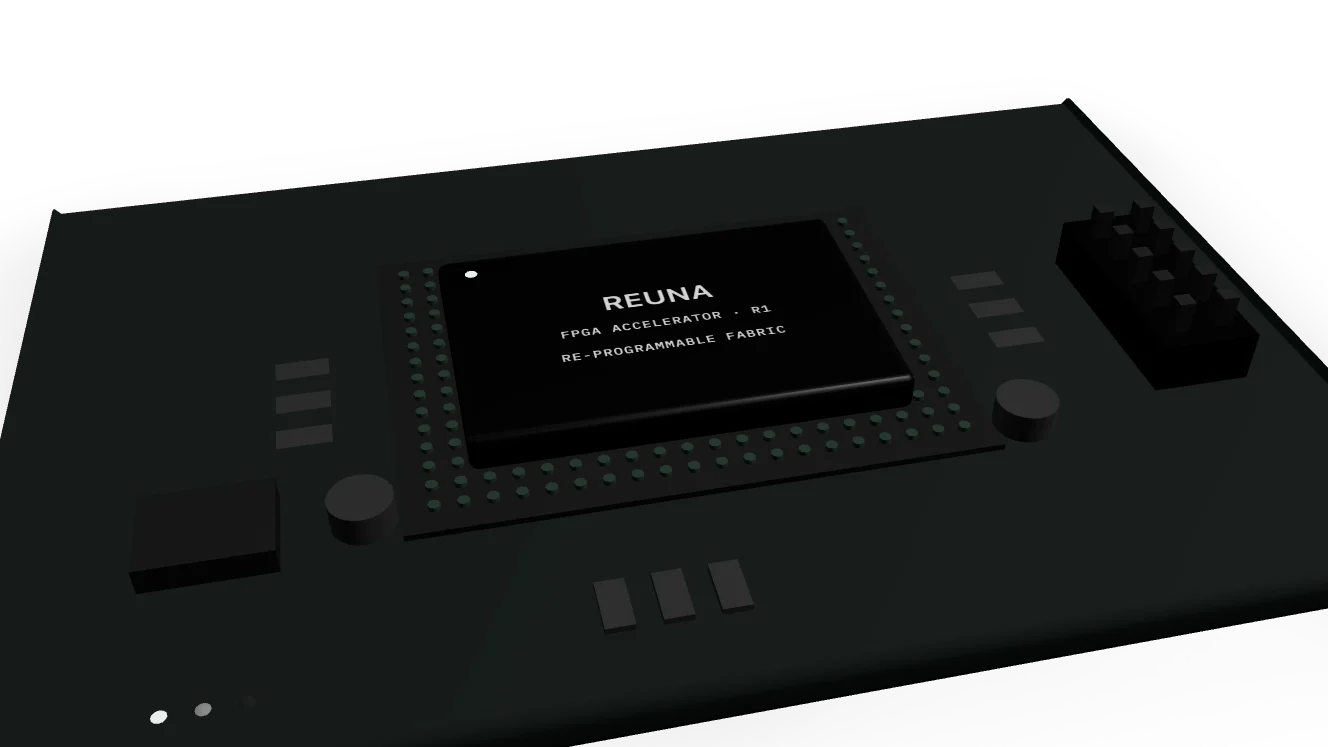
The Reuna FPGA accelerator runs your ONNX model as bare-metal logic. No operating system, no drivers, and because the fabric is re-programmable, the silicon itself can change after the product ships.
The only real option is a GPU board: an operating system, drivers, CUDA, Python, and 10 to 15 watts. Most devices are battery-powered, cheap, small, and offline. Drag the slider and watch what the same job costs on each.
If your team can export a model, they can ship it on Reuna. The compiler turns a standard ONNX file into lean bare-metal code for our microcontroller or our FPGA-based accelerator, and either one talks to the rest of your board over a four-wire SPI link that nearly every device already has.
No runtime to port, no drivers to write. The compiler reads the ONNX graph, quantises it, schedules it for the target, and emits bare-metal C you flash like any other firmware.
PyTorch, TensorFlow, whatever the team already uses.
The industry-standard model file. One click in most tools.
Model in, bare-metal code out. No OS in between.
Our microcontroller for low power, our FPGA accelerator for real time. Offline, over SPI.
Your model. Your chip. Our compiler. Femto Pro compiles for the chip you already ship. Upload a model, download firmware, flash. Try the fit check below: estimates are scaled from our YOLOv5s build, real numbers come from Femto Pro.
Two different chips for two different jobs. The microcontroller is for low-power devices that check in every few seconds. The FPGA accelerator is for machines that need answers in milliseconds. Same model, same toolchain, same interface on both.
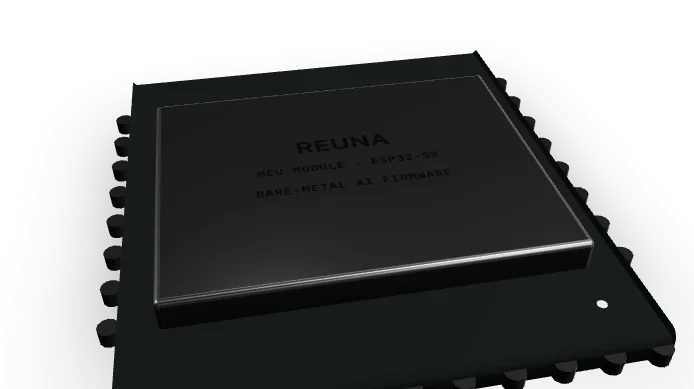
Compile your AI onto the microcontroller already in your product, or use the Reuna module. We run YOLOv5 on a $5 ESP32-S3: 23 seconds per image stock, about 5 after Reuna optimisation, on identical hardware. Update the model with a firmware push, never a hardware swap. Updatable, not re-programmable: that's the accelerator's job.
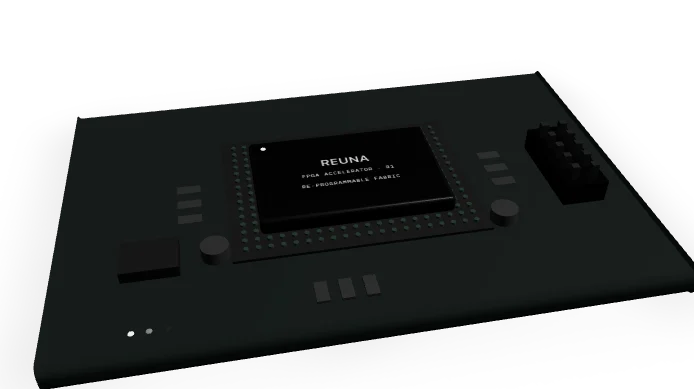
Our FPGA-based accelerator for drones, robots, vehicles, and any device that needs faster inference and quicker decisions on board. Faster than a GPU board at a quarter of the power, and because the hardware itself is re-programmable, you can change what it does after the product ships. Not just the model, the silicon.
Cabin cameras that wake a drowsy driver. Startups are building this on ESP32 today; we make the AI actually fit.
Obstacle avoidance and on-board detection without a GPU eating the battery.
Livestock counting and fence-line sensors in fields with no signal.
Defect detection and safety-zone monitoring on the machine itself.
Perimeter cameras that raise a real alert instead of recording hours of nothing.
Perception in milliseconds, offline.
Toys, appliances, wearables. Voice and vision on a few-dollar chip.
Same stack, restricted deployments. Offline, deterministic, no OS to attack.
All the AI on board, on Reuna hardware. Detect, track, act, no cloud. See the live patrol demo.
Building a drone, a robot, a camera, a sensor, a toy? If it exports to ONNX, we can run it on your hardware or ours.

